Friday, April 30, 2010
Propylthiouracil and severe liver injury
The FDA has just added a black box warning despite the fact that this risk has been known for some time. Methimazole is now designated the drug of choice.


Is medical education going full circle?
A while back I wrote that medical eduction was slouching towards pre-Flexnerian standards due to the growing influence of unscientific complementary and alternative medicine in the curricula. Now, according to a new article in Academic Medicine, we may be slouching in more ways than one, out of pressure to address the shortage of primary physicians. You can get the full text free from Medscape.
Thursday, April 29, 2010
The value of a proactive geriatrics consult service
This idea goes against the popular hospitalist mindset. At first glance it seems redundant and wasteful. After all, don't hospitalists do geriatric medicine day in and day out? So why bring in another team? Because, at least in one study, it reduced utilization and resulted in better care.
The model was profiled in Today's Hospitalist:
In other words the hospitalists can't do it all. These patients got better and more efficient care thanks to early involvement of the geriatrics team.
Related post here.
The model was profiled in Today's Hospitalist:
"Geriatrics excels at more nebulous aspects of caring for older patients, not the nitty-gritty treatment of medical illness," Dr. Botkin says. "Many people don’t recognize how important these aspects are and how they add up to providing better care."
...A big factor in the service’s success is that ACE team members are brought in almost immediately, says Dr. Botkin. While hospitalists can call a traditional geriatric consult for a patient with delirium, the ACE team is activated when the admitting hospitalist checks a box on the general admission order set.
...Within a day, the service may be ordering physical therapy, for instance, or phoning family members in California—tasks that Dr. Botkin may not get to for several days.
"When I’m spending 45 minutes managing acute illness," he explains, "the service saves me another 30 minutes making sure the patient won’t be left alone at home after discharge." Just as importantly, he adds, the early intervention helps prevent functional decline.
In other words the hospitalists can't do it all. These patients got better and more efficient care thanks to early involvement of the geriatrics team.
Related post here.
Wednesday, April 28, 2010
Takotsubo cardiomyopathy: what are the mechanisms?
Essentially endogenous catecholamine overdose followed by disturbances in intramyocardial calcium metabolism. Review here.
You might be a hospitalist
Funny stuff from Eric DeLue:
Read the rest here.
You might be a hospitalist if a general surgeon asks you to admit a 24-year-old with acute appendicitis because of the patient’s comorbid condition: allergic rhinitis.
You might be a hospitalist if the orthopedist consults you for medical management— after you’ve already been seeing the patient for the past three days.
You might be a hospitalist if the ED doctor tells you, "Admission, room 6." When you ask, "Any more information?", he says, "Yeah, thanks for asking. Admission, room 7, too."
Read the rest here.
Tuesday, April 27, 2010
Review of TTP and related thrombotic microangiopathies
The experience of the Oklahoma TTP Registry, a database of patients referred for plasma exchange from 1989 to 2008, is the topic of an open access review in Blood. A few points of interest follow:
Survival in TTP improved dramatically with the advent of plasma exchange but plateaued after that, with no difference in survival for the two 10 year periods (68 vs 69%).
The advent of plasma exchange and the need for early treatment reduced diagnostic stringency. In the pre-exchange era almost all patients exhibited the pentad. Now, only microangiopathic hemolytic anemia and thrombocytopenia (without other explanation) are required as the threshold for starting treatment. This early treatment has reduced expression of the other clinical features, with the result that the pentad is less often seen. Early treatment with a less stringent threshold has also increased the heterogeneity of the disease.
TTP may be idiopathic or secondary. Clinical profiles, survival and relapse rates in relation to these two categories and to ADAMTS 13 levels are detailed in the text.
The distinction between TTP and HUS is not always clear, particularly given the less stringent diagnostic criteria and early treatment, which may commence before ADAMTS 13 levels are available. From the paper:
TTP is more heterogeneous than commonly appreciated, such that the classification of patients into idiopathic and secondary TTP is simplistic. From the discussion section of the paper:
CME is available at Medscape.
Survival in TTP improved dramatically with the advent of plasma exchange but plateaued after that, with no difference in survival for the two 10 year periods (68 vs 69%).
The advent of plasma exchange and the need for early treatment reduced diagnostic stringency. In the pre-exchange era almost all patients exhibited the pentad. Now, only microangiopathic hemolytic anemia and thrombocytopenia (without other explanation) are required as the threshold for starting treatment. This early treatment has reduced expression of the other clinical features, with the result that the pentad is less often seen. Early treatment with a less stringent threshold has also increased the heterogeneity of the disease.
TTP may be idiopathic or secondary. Clinical profiles, survival and relapse rates in relation to these two categories and to ADAMTS 13 levels are detailed in the text.
The distinction between TTP and HUS is not always clear, particularly given the less stringent diagnostic criteria and early treatment, which may commence before ADAMTS 13 levels are available. From the paper:
Because standard practice in this region is to treat all adults who are diagnosed with either TTP or HUS and all children who are diagnosed with TTP with PEX, the Registry is a population-based inception cohort of consecutive patients in whom a diagnosis of TTP or HUS is made and PEX is requested. Children with typical (diarrhea-associated) HUS are not typically treated with PEX; therefore, most of these children are not included in the Registry...
Because these syndromes in adults, with or without renal failure or neurologic abnormalities, are commonly known as TTP, because Registry patients are almost all adults, and because patient descriptions focus on clinical presentations and levels of ADAMTS13 activity without testing for abnormalities of complement regulation, we describe patients in this report as having TTP. We recognize that some of our patients may be appropriately described as HUS, rather than TTP, particularly if complement regulatory abnormalities had been recognized or if a Shiga-like toxin-associated infection had been identified.
Categories of patients with TTP were: (1) allogeneic HSCT, (2) pregnancy/postpartum, (3) drug association, (4) bloody diarrhea prodrome, (5) additional or alternative disorder, and (6) idiopathic.
Patients within category 5 were further subdivided. The subdivisions included systemic infection, malignancy and autoimmune disorder (see Table 1).
TTP is more heterogeneous than commonly appreciated, such that the classification of patients into idiopathic and secondary TTP is simplistic. From the discussion section of the paper:
Patients defined as idiopathic were also heterogeneous. Although these patients were not recognized to have any of the conditions defining the other established clinical categories, some had preceding or concurrent conditions, such as pancreatitis, infections, or surgery which may have triggered the onset of TTP, reflecting the current arbitrary definition of "idiopathic" TTP. Only 46 (47%) of the 98 patients defined as idiopathic had ADAMTS13 activity below 10%.
Even patients who presented with ADAMTS13 levels below 10% were heterogeneous, initially presenting in multiple clinical categories (HSCT, postpartum, bloody diarrhea prodrome, additional or alternative disorders, as well as idiopathic). This experience suggests that dichotomous descriptions of TTP as either idiopathic or secondary do not accurately represent the heterogeneity among patients who are diagnosed and treated for TTP.
CME is available at Medscape.
Risk management and patient safety often conflicting goals
Those of us who work in health care live in a culture of blame. The Institute of Medicine's egregious spin of data on patient harm and wrong thinking about never events added fuel to the fire with the result that the patient safety movement backfired.
DB's Medical Rant's offers a case in point:
DB's Medical Rant's offers a case in point:
Talking to a colleague recently, he told me about a teaching case. The patient had almost died and a root cause analysis led to many important teaching points. He wanted to do an M&M presentation, and had to defy the hospital lawyers. The lawyers (at his hospital) told him that he should wait 8 years to use the case in a teaching conference.
Pharma critics and pharmascolds
Although the pharmaceutical industry has brought us remarkable advances in patient care it is not above criticism. Pharma critics deliver nuanced, balanced criticism of industry. They are to be distinguished from pharmascolds. Steve Novella, blogging at Science Based Medicine, explains the distinction (my italics):
He goes on to cite an article accusing the pharmaceutical industry of disease mongering as an example. There are many pharmascolding web sites. You're probably familiar with some of them. They share certain characteristics: they summarily reject research and educational activities that receive support from industry; they automatically assume that any researcher or educator with industry ties is corrupt and untrustworthy; they imply that no important biases or conflicts of interest exist apart from industry; they predictably react with glee at news of industry's embarrassment or misfortune; they label those who question their assumptions as pharma shills; they operate under the illogical assumption that industry's interests are always in conflict with patients' interests.
I've been falsely branded a pharma shill because I have opposed a ban on industry supported CME, have suggested that individual doctors should make their own decisions about interaction with industry, and have criticized many forms of complementary and alternative medicine.
It has become fashionable, however, to not only criticize the pharmaceutical industry but to demonize them – and the term “big pharma” has come to represent this demonization. Cynicism is a cheap imitation of skepticism – it is the assumption of the worst, without careful thought or any hint of fairness.
He goes on to cite an article accusing the pharmaceutical industry of disease mongering as an example. There are many pharmascolding web sites. You're probably familiar with some of them. They share certain characteristics: they summarily reject research and educational activities that receive support from industry; they automatically assume that any researcher or educator with industry ties is corrupt and untrustworthy; they imply that no important biases or conflicts of interest exist apart from industry; they predictably react with glee at news of industry's embarrassment or misfortune; they label those who question their assumptions as pharma shills; they operate under the illogical assumption that industry's interests are always in conflict with patients' interests.
I've been falsely branded a pharma shill because I have opposed a ban on industry supported CME, have suggested that individual doctors should make their own decisions about interaction with industry, and have criticized many forms of complementary and alternative medicine.
Monday, April 26, 2010
CPOE and patient safety
From a study published in Health Affairs:
I don't have access to the full text of this article. I wonder how the investigators could tell which orders would have resulted in fatalities and how they defined serious adverse drug events. More importantly, how many hazzards were created by CPOE?
Via Today's Hospitalist.
A national sample of sixty-two hospitals voluntarily used a simulation tool designed to assess how well safety decision support worked when applied to medication orders in computerized order entry. The simulation detected only 53 percent of the medication orders that would have resulted in fatalities and 10–82 percent of the test orders that would have caused serious adverse drug events. It is important to ascertain whether actual implementations of computerized physician order entry are achieving goals such as improved patient safety.
I don't have access to the full text of this article. I wonder how the investigators could tell which orders would have resulted in fatalities and how they defined serious adverse drug events. More importantly, how many hazzards were created by CPOE?
Via Today's Hospitalist.
Metformin and vitamin B 12 deficiency
A recent SMJ article (full text via Medscape) presented a case of B 12 deficiency neuropathy induced by metformin mistaken for diabetic neuropathy. This has been known for a while and I first mentioned it here. With increasing numbers of patients on metformin for years at a time we're more likely to see this. Don't forget PPI's can do it too.
Applied hypothermia after resuscitation from cardiac arrest: it's not that hard (or expensive)
Here's a paper reporting the experience at a community hospital.
Friday, April 23, 2010
Paper critical of NCCAM and AMSA woo curriculum project drew angry responses

Why is academic medicine devolving into quackademic medicine? What are the driving forces? One is the AMSA foundation's EDCAM project. EDCAM was funded by a grant from the NCCAM and tasked with developing and promoting integrative medicine curricula in MD and DO granting medical schools. You can browse some of EDCAM's curriculum resources here and view AMSA's list of some med school CAM programs here (Orac, you've been wanting to update your Academic Woo Aggregator---I haven't compared this list against yours but maybe there's something there).
So last October I linked to this paper (free full text via Medscape here) which was critical of the EDCAM curriculum and concluded (my emphasis):
These “evidence-based CAM” curricula, which are used all over the country, fail to meet the generally accepted standards of evidence-based medicine. By tolerating this situation, health professions schools are not meeting their educational and ethical obligations to learners, patients, or society.
Those strong words drew a strong and angry response, mainly from the boosters of CAM, which you can read in the letters to the editor in the February issue. One of the paper's authors, in response, (if y'all will indulge me in a little self-aggrandizement) concluded by making the same point about the Flexner Report I first made several years ago in this blog and wrote about here. He wrote:
One hundred years ago the Flexner Report brought about reforms that made science and scholarship the basis of medical education in the United States. Advances in science resulted in remarkable progress in our understanding of human physiology and disease. Advocacy of unproven and implausible alternative therapies is a regression to the pre-Flexner era. It is an educational failure that needs to be acknowledged and rectified.
Sit! Stay!
Sit down when you visit the patient. She'll think you spent more time, whether you really did or not. (Now don't think that'll improve your Press-Ganey scores. Research quality data shows they don't mean squat).
Via Med Rants.
Via Med Rants.
Thursday, April 22, 2010
Is Berwick the one?
Imagine a health care policy leader whose vision for patient centered care is to give individual patients exactly the care they want, whenever they want it. Imagine that policy leader being “open” to non-evidence based and implausible integrative medicine. Imagine that person as the head of CMS. Imagine the possibilities.
Wednesday, April 21, 2010
Retired Doc on health care reform
In a way, criticisms surrounding the health care reform bill resemble those surrounding the patriot act: an opportunistic rush to implementation in a time or crisis; senators and representatives who didn't read the entire bill; bending the Constitution; threats to individual liberty; sweeping executive powers which circumvent legislative or judicial approval; and unintended consequences.
Retired Doc has been on a roll with a series of must read posts which serve as a repository of these concerns:
So who will do well and who will not as the Medical Care "reform" is enacted
As business realize Obamacare will cost them,congress will demand what?
Compulsory medical insurance -but not until after the next presidential election
Health care "reform:,wouldn't it be nice to think so?
Could the Independent Medicare Advisory Board pave the way to an exclusive single payer?
Section 10320 of health care bill-reason to be afraid
More "well thought out" parts of the massive health care bill deserve worry
So how does the Obama health care bill "provide" health care for almost everyobody?
The Health care bill- No one knows what it will do but don't worry
Yet another government entity emerges from the health care bill
Which is more frightening , Section 10320 of the PPACA or Section 2713?
Ironic example of the unintended consequences of the health care bill
Section 10320 of PPACA, let me be perfectly clear
So how might section 10320 (of health care bill) be implemented
Thinking beyond stage one in the health care bill
New Health care bill not long enough ? we need more pages ? And are insurers now utilities or not?
Retired Doc has been on a roll with a series of must read posts which serve as a repository of these concerns:
So who will do well and who will not as the Medical Care "reform" is enacted
As business realize Obamacare will cost them,congress will demand what?
Compulsory medical insurance -but not until after the next presidential election
Health care "reform:,wouldn't it be nice to think so?
Could the Independent Medicare Advisory Board pave the way to an exclusive single payer?
Section 10320 of health care bill-reason to be afraid
More "well thought out" parts of the massive health care bill deserve worry
So how does the Obama health care bill "provide" health care for almost everyobody?
The Health care bill- No one knows what it will do but don't worry
Yet another government entity emerges from the health care bill
Which is more frightening , Section 10320 of the PPACA or Section 2713?
Ironic example of the unintended consequences of the health care bill
Section 10320 of PPACA, let me be perfectly clear
So how might section 10320 (of health care bill) be implemented
Thinking beyond stage one in the health care bill
New Health care bill not long enough ? we need more pages ? And are insurers now utilities or not?
Tuesday, April 20, 2010
Thoughts and impressions after returning home from Hospital Medicine 2010

HM 2010 was a wonderful experience. I'll be spending the next few weeks reviewing course materials, thinking about how to incorporate changes into my practice, and reflecting on what the experience meant to me. I've done this throughout my career. In recent years blogging about meetings has added a new dimension. I tried to blog HM 2010 in real time. That lasted one day. The delivery of content was too fast for me to do it justice. Ideas and research findings in medicine are seldom “breaking news” and I prefer to offer discussion and links to background sources rather than a series of sound bites. I'll be doing that (if no one else is interested, just for my own reference) with some of the remaining course content in the near future.
On the final day of sessions we were treated to a talk by Bob Wachter. Though he and I are polar opposites on the political spectrum I find his talks insightful and entertaining. He discussed how health care reform---both the law itself and the conversation surrounding it---might affect hospitalists. If you're a follower of his blog you can imagine some of the things he had to say. As he has said there, there will be a major new emphasis on shared accountability and integration---attributes that separate the Mayos from the McAllens of the world. (Look for ACO to be the new HMO). He suggested, as he has said before in his blog, that hospitalist groups might have a role in promoting such integration in their local communities. Up to now, unfortunately, the growth of hospital medicine seems to have had the opposite effect. Will that change under new incentives? It's anybody's guess.
An important piece of integration lies in improving transitions between hospital and clinic. The transitions problem is exacerbated by the shortage of primary care physicians. One idea that's gaining traction was mentioned several times at HM 2010: hospitalists running post-discharge clinics. I have commented before that I oppose that idea. Follow up care of high acuity post-discharge patients is important but it is the role of the primary care physician. Hospitalists who staff such clinics are reverting to the role of the traditional internist. They are no longer hospitalists. The hospitalist model of care built a disconnect between hospital medicine and clinic medicine, and that disconnect is a quality and safety problem. The logical extension of the post-discharge clinic would be to address that safety problem by dismantling the hospitalist movement altogether.
I came away from HM 2010 a little less cynical about the Society of Hospital Medicine. I truly believe they approach quality and safety for hospitalized patients with a level of sincerity and vigor unmatched by any other professional organization. That said, I'm still troubled by their uncritical acceptance of faulty ideas about such things as performance measures, never events and hospitalists as utility players.
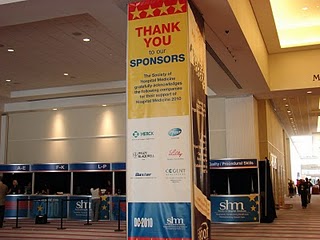
Finally, a few words about the exhibit hall. The high level of industry support was readily apparent. The SHM annual meeting would not be of the quality it is without such support. I am more convinced than ever that the “firewalls” were adequate to address any conflicts of interest. Public access to the digital archives of the meeting presentations will be available in about a month. I challenge anyone to cite bias or other degradation of content related to industry support. But what was most impressive about the exhibit hall was the number of recruiting displays by health care systems and staffing companies. There are still plenty of hospitalist jobs out there!
Acute and chronic sleep deprivation
The older I get the more I appreciate the benefits of sleep. So I found this study interesting.
In other words a 10 hour session of “make up” sleep is not restorative if sleep deprivation is chronic, defined as getting 7 or fewer hours sleep per night over time. Researchers don't know how long it takes to recover from chronic sleep deprivation other than to say that 3 days doesn't seem to be enough.
I work a 7 day on 7 day off schedule and this rings true to me. I progressively accumulate sleep debt during the on week. It seems to take most of the off week to recover. But it was even worse back in the days of working every week with rotating night call---like having jet lag once a week.
H/T to Clinical Cases and Images.
Sleep loss leads to profound performance decrements. Yet many individuals believe they adapt to chronic sleep loss or that recovery requires only a single extended sleep episode...
Despite recurrent acute and substantial chronic sleep loss, 10-hour sleep opportunities consistently restored vigilance task performance during the first several hours of wakefulness. However, chronic sleep loss markedly increased the rate of deterioration in performance across wakefulness, particularly during the circadian “night.” Thus, extended wake during the circadian night reveals the cumulative detrimental effects of chronic sleep loss on performance, with potential adverse health and safety consequences.
In other words a 10 hour session of “make up” sleep is not restorative if sleep deprivation is chronic, defined as getting 7 or fewer hours sleep per night over time. Researchers don't know how long it takes to recover from chronic sleep deprivation other than to say that 3 days doesn't seem to be enough.
I work a 7 day on 7 day off schedule and this rings true to me. I progressively accumulate sleep debt during the on week. It seems to take most of the off week to recover. But it was even worse back in the days of working every week with rotating night call---like having jet lag once a week.
H/T to Clinical Cases and Images.
Monday, April 19, 2010
Pro-BNP levels in the evaluation of patients presenting with chest pain
Patients with chest pain who “rule out” with negative ECGs and troponin levels present a difficult problem because although they lack objective signs of ischemia their symptoms may still have represented cardiac pain, placing them at risk for future events. Pro-BNP was shown to provide incremental prognostic information in such patients in a previous study.
A new study by the same authors compared the conventional strategy of stress testing such patients against a new strategy of combining a clinical risk score with Pro-BNP testing and found equivalent outcomes:
Free full text via Medscape here.
A new study by the same authors compared the conventional strategy of stress testing such patients against a new strategy of combining a clinical risk score with Pro-BNP testing and found equivalent outcomes:
Results
A total of 110 patients (69%) were hospitalized using usual management in comparison with 90 (56%) in the new strategy (P = .03). There were no differences in death or myocardial infarction (n = 11, 6.9% vs n = 6, 3.8%, P = .3) or cardiac events (n = 38, 24% vs n = 28, 18%, P = .2). Revascularizations at the index episode were more frequent under usual management (18% vs 8%,P = .01), although the new strategy was associated with higher rate of planned postdischarge revascularizations (0.6% vs 5%, P = .04).
Conclusions
A strategy combining clinical history and NT-proBNP is simpler and reduced initial emergency hospitalizations in patients with chest pain, in comparison with the usual strategy involving exercise testing. Larger studies to assess its impact on long-term hard end points are needed.
A caveat not mentioned by the authors is that Pro-BNP levels may be falsely low in patients with obesity. A Pro-BNP cut off of 110 was used.
Free full text via Medscape here.
Subscribe to:
Posts (Atom)